Swordfish – Number Place (Sudoku) Solving Technique
Swordfish extends X-Wing to a 3-row × 3-column pattern. When a specific number’s candidates in three rows exist within only the same three columns, you can eliminate that number from other cells in those three columns.
Basic Rules of Number Place
First, let's reconfirm the basic rules:
- Place the numbers 1–9 in each row, column, and 3×3 block.
- Do not repeat the same number in any row, column, or block.
- The puzzle is clear once all cells are correctly filled.
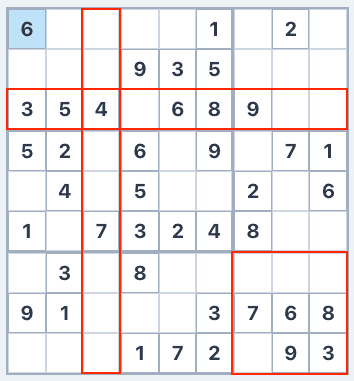
Overview of Swordfish
Swordfish is a pattern where a number’s candidates in three rows each appear in at most three columns, and those columns total only three distinct columns. While X-Wing is a 2×2 pattern, Swordfish is a 3×3 pattern. Each row’s candidates can be in 2 or 3 columns — as long as the total stays within 3 columns, the pattern holds.
How to Use Swordfish
Focus on a specific number and check which cells in each row have it as a candidate.
Find three rows where the number appears in 2–3 columns.
If the columns used across all three rows total only 3, you have a Swordfish.
Eliminate the target number from other rows’ cells in those three columns.
Example
Suppose ‘6’ appears in columns 2 and 5 of row 1, columns 2 and 9 of row 4, and columns 5 and 9 of row 7. The columns used are 2, 5, and 9 — just three. Since ‘6’ must go somewhere in these 3 rows × 3 columns, you can remove ‘6’ from columns 2, 5, and 9 in all other rows.
Tips for Finding Swordfish
First, make sure you understand X-Wing well, then extend the concept to 3 rows × 3 columns. Find three rows where the target number has candidates in only 2–3 cells, then check if the columns total 3 or fewer. While rare, it’s essential for solving the hardest puzzles.